
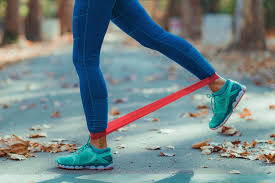
You may have seen numerous people use resistance bands like the picture above for gluteal activation and resistance training. This exercise has become a favorite for many famous social media fitness influencers. The utility of this exercise has been popularized in the Rehab community to help with lower cross syndrome. Lower cross syndrome is a functional diagnosis that was popularized by a Czech Medical Doctor named Vladimir Janda. He proposed that lower cross syndrome is a function of muscle imbalances that occur from poor postures. He noticed that from poor postures such as sitting for lengths of time can produce tight hip flexors and weak hip extensors, generally speaking.
The resistance band gluteal exercise has been a staple exercise as of late which has motivated researchers to study resistance band placement and muscle activation patterns. The researchers placed bands around the knees, ankles (pictured above) and feet. They found that placing the bands around the feet had the greatest amount of Gluteal muscle activation. They also found that placing the band around the foot preferentially activated the gluteal muscles over the tensor fascia latae muscle. This point is important as this brings us back to the lower cross syndrome. Since the tensor fascia latae muscle is a hip flexor, it tends to be over active in people with lower cross syndrome and therefore must be identified as a muscle to lengthen instead of activating.
In general this article has given some great insight on how to isolate the gluteal muscles without activating other unwanted musculature. So remember to place the band around your feet the next time you perform this exercise !
Research article reference
Cambridge, E. D., Sidorkewicz, N., Ikeda, D. M., & McGill, S. M. (2012). Progressive hip rehabilitation: the effects of resistance band placement on gluteal activation during two common exercises. Clinical Biomechanics, 27(7), 719-724.

